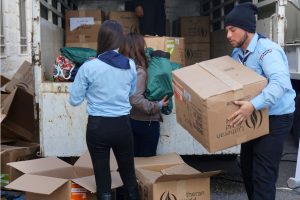
The Robin Hood Foundation in New York City raised $67.5 million for Superstorm Sandy relief and it is expected that all of it will be out the door by the end of next month. “It goes back to donor intent,” said Emary Aronson, Robin Hood’s managing director of education and the Robin Hood Relief Fund. “People didn’t give money for us to hold for a year or two. They gave because people are cold and hungry.”
Aronson was part of a panel discussion this morning at the Better Business Bureau’s Charity Effectiveness Symposium called “Lessons from Sandy: What Funders and Grantees Are Learning.” She was joined by representatives of the Brooklyn Community Foundation (BCF) and the Long Island Community Foundation (LICF).
Robin Hood has been able to get the money to where it’s needed most by relaxing its grant application and reporting requirements. Other New York area grantmakers have taken the same tactic to efficiently disperse funds for hurricane relief and recovery.
Robin Hood, BCF and LICF all streamlined their grant application process in the immediate aftermath of the storm. “We’re stewards of others’ money, so evaluation is very important,” said David Okorn, the Syosset, N.Y.-based LICF’s executive director. “We saw who was doing what and just made grants.” Instead of demanding a long, involved proposals, “just give us bullets with statistics” about how much relief goods would be distributed or number of people served, Okorn said LICF told grantees. LICF “didn’t want to be overly burdensome,” said Okorn, because organizations and the people they served needed the grant money right away.
Fluidity and adaptability are extremely important in a crisis, said the panelists. Having emergency response and continuity of operations plans in place and up-to-date separated organizations that were able to operate effectively immediately after Sandy from those that were not able. “When you’ve lost power and can’t get to your office, or everything’s stored electronically, what do you do?” asked Okorn.
Sandy was such a calamity that the panelist grantmakers and their grantees couldn’t operate effectively enough on their own. Forming collaboratives, both on the foundation side and on the service provider side, was integral in coordinating the disaster response throughout the affected areas. “You should not be standing alone without partnership with government and business,” said BCF President Marilyn Gelber.
BCF, based in New York City, helped put together five community boards that collectively representative a population of about 700,000 Brooklynites. It used the collaboratives to determine the needs of the community and how the foundation might be able to respond to them. “The results of convening were that we understood the direction that fundraising had to follow,” said Gelber. Between fast-track $10,000 grants and a call for larger Requests for Proposals (RFPs), BCF was able to distribute about $600,000 in the first three weeks after the storm.
Foundations love to see their grantees collaborate, but in the wake of Sandy, LICF took the somewhat unusual step of partnering with other grantmakers to share and obtain information while Internet and phone capabilities were nonexistent and media coverage was sparse. Okorn said LICF started a funders’ collaborative and partnered with local businesses while they waited “to see what has not been funded yet.” The next step was to interview nonprofits and fund projects that met both recovery and preparation needs.
Although all three organizations make grants in areas largely untouched by Sandy, they said the lessons learned in the storm would inform their grantmaking decisions to all their grantees. “The lessons we learned about communication and support in coastal communities must be brought inland,” said Gelber. “While this was a test of who you are and your ability to react and connect on a local level, the legacy will be for foundations throughout Brooklyn to be more engaged with neighborhoods. If we work more closely together across sectors to focus on neighborhoods more holistically, the foundation community can be more effective.”